

Essence
The Decentralized Volatility Engine (DVE) Architecture represents a structural leap beyond simple peer-to-peer or order book models for crypto options. It is fundamentally an automated, on-chain mechanism designed to aggregate and synthesize liquidity across disparate strike prices and expiration dates into a single, highly efficient risk pool. The core function is to allow market participants to buy or sell volatility exposure ⎊ specifically Vega and Gamma ⎊ without requiring the system to hold a massive, static inventory of individual option contracts.
This abstraction is critical; it shifts the liquidity burden from managing an N × M matrix of strikes and expiries to managing the systemic risk of the underlying asset’s price and volatility distribution. The system’s design centers on a dynamically hedged vault, often called the Volatility Pool. This pool acts as the counterparty to all trades, accepting premium for sold options and paying out for bought options.
The pool’s solvency is maintained through two primary mechanisms: automated delta-hedging in the underlying spot market, and a sophisticated, real-time calculation of the pool’s overall Greeks ⎊ its sensitivity to changes in price, time, and volatility. Our inability to respect the skew is the critical flaw in our current models, which the DVE attempts to solve by baking the skew into its capital requirements.
The Decentralized Volatility Engine Architecture abstracts individual options contracts into a single, dynamically managed pool of systemic volatility risk.
The ultimate goal of the DVE is capital efficiency. By treating all option trades as flows into a single, composite risk profile, the system can use cross-margining principles to drastically reduce the collateral required per trade compared to traditional, siloed options exchanges. This is achieved by netting exposures: a short call and a short put with similar delta exposures partially offset one another, freeing up collateral that can then be deployed elsewhere, accelerating the market’s natural gravitational pull toward the protocol.


Origin
The intellectual origin of the DVE Architecture lies at the intersection of two distinct financial domains: the traditional finance concept of the Volatility Surface and the decentralized finance innovation of the Automated Market Maker (AMM). Traditional over-the-counter (OTC) options desks and proprietary trading firms have long operated on a model where a central desk internalizes all option trades and manages a single, large portfolio hedge ⎊ the DVE simply decentralizes this desk. The technical foundation, however, is a direct evolution of the simple constant-product AMM.
The initial attempts at on-chain options suffered from catastrophic liquidity fragmentation. A standard AMM is effective for a single token pair, but an options market requires a separate pool for every strike, every expiry, and every side (call/put). This combinatorial explosion rendered early decentralized options protocols unusable.
The DVE’s genesis was the realization that the liquidity function needed to be generalized from x · y = k to a function that models the implied volatility curve itself. The initial iterations borrowed heavily from the Black-Scholes-Merton framework, attempting to invert the pricing formula to determine the optimal liquidity curve shape. This led to the creation of the first Synthetic Liquidity Pools , where the assets in the pool are not the option and the underlying, but the collateral and a dynamic, calculated liability representing the pool’s net Vega exposure.


Theory
The mathematical core of the DVE Architecture rests on a dynamic equilibrium maintained by a Stochastic Volatility Model ⎊ a necessary departure from the static assumptions of Black-Scholes, given the heavy-tailed nature of crypto asset returns. This is where the pricing model becomes truly elegant ⎊ and dangerous if ignored. The DVE does not use a fixed-strike, fixed-expiry model; it uses a Continuous Volatility Pricing Function V(S, τ, σ) where S is the underlying price, τ is time to expiry, and σ is the instantaneous implied volatility.

Pricing Mechanism and Risk Synthesis
The protocol synthesizes the price of an option using a Liquidity-Sensitive Implied Volatility (LSIV) curve. This curve is not simply observed from an order book; it is calculated based on the pool’s current risk inventory and the available collateral. This calculation is a continuous balancing act between supply, demand, and systemic exposure ⎊ a critical piece of Protocol Physics that governs financial settlement.
- Risk Inventory: The aggregate sum of all active positions, weighted by their Vega and Gamma sensitivities. This determines the pool’s current exposure profile, providing a necessary, granular view of the pool’s directional risk.
- Capital Buffer: The total amount of collateral available in the pool, which directly dictates the maximum permissible Systemic Leverage Ratio.
- Pricing Penalty Function: As the pool’s risk inventory increases in a particular direction (e.g. net short Vega), the LSIV function dynamically increases the implied volatility for new trades in that same direction, making those trades more expensive ⎊ a powerful, autonomous risk-mitigation tool.

Dynamic Margin and Liquidation Physics
Liquidation within the DVE is a function of the pool’s overall solvency, not just the individual trader’s position. The Maintenance Margin for a position is not static; it is a real-time calculation of the capital required to hedge the position’s worst-case-scenario movement in the underlying asset and implied volatility over a short time horizon ⎊ say, a 15-minute window ⎊ a crucial difference from simple fixed collateral ratios.
| Parameter | Traditional Fixed Margin | DVE Dynamic Margin (WCS) |
|---|---|---|
| Calculation Basis | Fixed percentage of notional value. | Value-at-Risk (VaR) of position’s Greeks. |
| Input Variables | Notional, Asset Price. | Asset Price, Implied Volatility, Vega , Gamma , Time. |
| Liquidation Trigger | Margin Ratio falls below 100%. | Pool’s Systemic Risk Score exceeds a predefined threshold. |
This approach, while computationally intensive, ensures that the system’s risk management is proactive, focusing on potential systemic failure rather than lagging individual account balances.


Approach
The current implementation of the DVE Architecture relies on a modular, three-layer design to balance computational complexity with on-chain security. This structure is a necessary compromise to fit advanced quantitative models within the gas limits and latency constraints of existing Layer 1 and Layer 2 networks.

Layered Architecture for Risk Management
- Settlement Layer: Handles collateral deposit, withdrawal, and final settlement of trades. This layer is minimal, focusing only on secure custody and execution of the core Hedge Rebalancing Call ⎊ the instruction to buy or sell the underlying asset to re-delta the pool.
- Pricing Engine Layer: This is the computational heart. It runs the complex LSIV model, calculates all the pool’s Greeks , and determines the new margin requirements. This data is cryptographically signed and submitted on-chain via a specialized, low-latency oracle network ⎊ a critical element of the Market Microstructure.
- Liquidity Provision Layer: The user-facing interface where Liquidity Providers (LPs) deposit capital. LPs receive a token representing their share of the Volatility Pool and, crucially, are exposed to the unhedged volatility risk, compensated by the collected option premium and trading fees.
The market microstructure created by the DVE is one of Automated Arbitrage. The protocol’s LSIV curve often deviates from the true market implied volatility surface, creating arbitrage opportunities for external market makers. These arbitrageurs ⎊ often sophisticated automated agents ⎊ act as the system’s external hedge, trading against the DVE to profit from the mispricing, which simultaneously pulls the DVE’s pricing back in line with the broader market and forces the DVE to execute its required delta-hedges.
Automated arbitrageurs function as the DVE’s external, decentralized risk-correction mechanism, keeping the protocol’s pricing anchored to the broader market.
The Behavioral Game Theory here is fascinating: the LPs are effectively playing a long-volatility-selling game, betting that the premium collected outweighs the cost of the system’s delta-hedging and the occasional large payout. Arbitrageurs, conversely, are playing a low-latency, low-spread game, extracting value from the system’s necessary computational lag.


Evolution
The evolution of the DVE Architecture has been a progression from simplicity to complexity, driven by the ruthless demands of market micro-structure.
Early versions utilized a Static Hedge Ratio ⎊ a fixed percentage of the pool’s delta was hedged, regardless of market conditions. This proved disastrous during periods of high volatility, leading to massive, unrecoverable losses for LPs when Gamma exposure spiked.

From Static to Dynamic Risk Budgeting
The key evolutionary step was the adoption of Dynamic Risk Budgeting. Instead of a fixed hedge, the system now calculates a maximum acceptable Risk Score ⎊ a composite metric that weights Vega , Gamma , and Skew exposure. When a new trade would push the pool’s Risk Score beyond this budget, the trade is either rejected or priced at a prohibitive implied volatility.
This shift transforms the DVE from a passive counterparty into an active risk manager, allowing the system to preemptively defend its capital buffer ⎊ a necessary defense against Systems Risk. The second major evolution is in Tokenomics & Value Accrual. Initial protocols struggled with the classic “liquidity mercenary” problem.
The solution was the introduction of a Protocol-Owned Liquidity (POL) mechanism, where a portion of the trading fees is used to buy and permanently lock the protocol’s native governance token.
| Mechanism | Old Model (Incentive Mining) | Current Model (Dynamic POL) |
|---|---|---|
| Fee Allocation | 90% to LP Rewards | 60% to LP Rewards, 40% to POL/Treasury |
| Token Utility | Simple Governance Voting | Governance, Fee Discount Staking, Insurance Fund Backing |
| Systemic Impact | High Emissions, Price Instability | Reduced Emissions, Direct Value Accrual to Protocol Treasury |
This creates a flywheel where trading activity directly strengthens the protocol’s balance sheet, providing a deeper capital buffer against catastrophic market moves ⎊ a critical defense against Systems Risk & Contagion.


Horizon
The future trajectory of the DVE Architecture is defined by two forces: the relentless pursuit of capital efficiency and the looming specter of regulatory clarity. The next phase of development centers on the concept of Cross-Chain Volatility Sharing.

Cross-Chain Risk Aggregation
Current DVE implementations are siloed to a single chain, meaning a separate capital pool is required for each deployment. The next architectural leap involves creating a canonical Risk Settlement Layer on a high-throughput chain that can receive signed, cryptographically verified risk reports ⎊ the aggregate Greeks ⎊ from satellite DVEs deployed across multiple Layer 2 and Layer 1 networks. This allows for a single, unified collateral pool to back option trades across the entire decentralized landscape, drastically increasing capital efficiency ⎊ and, of course, introducing new Systems Risk vectors for contagion.
A failure in one satellite DVE could theoretically drain the shared pool, making the security of the inter-chain communication bridge paramount.
The future of DVEs lies in unifying disparate liquidity pools into a single, capital-efficient risk settlement layer, shifting the systemic risk from single-protocol failure to bridge security.

Regulatory and Legal Arbitrage
The Regulatory Arbitrage & Law component is already shaping the design. The DVE’s reliance on a decentralized, automated liquidation process ⎊ where the system’s code, not a central authority, liquidates positions ⎊ presents a legal gray area. Future architectures will likely incorporate a “Kill Switch” Governance Module that allows a decentralized autonomous organization (DAO) to pause the system in the event of an external regulatory order or a catastrophic smart contract exploit.
This is not an admission of centralization, but a pragmatic recognition that real-world legal injunctions cannot be ignored ⎊ it is a necessary, self-imposed constraint on the Protocol Physics. The ultimate goal is a Generalized Options Primitive that can be easily composited into other DeFi protocols, such as using the Volatility Pool’s LP token as collateral in a lending protocol, creating a multi-layered financial derivative ⎊ a system of immense power, but one requiring vigilance against the inherent Smart Contract Security risks. The ability to pause the system, even temporarily, offers a necessary circuit breaker ⎊ a final line of defense against both code vulnerabilities and unpredictable market events ⎊ that must be designed into the very fabric of the protocol.

Aftermath
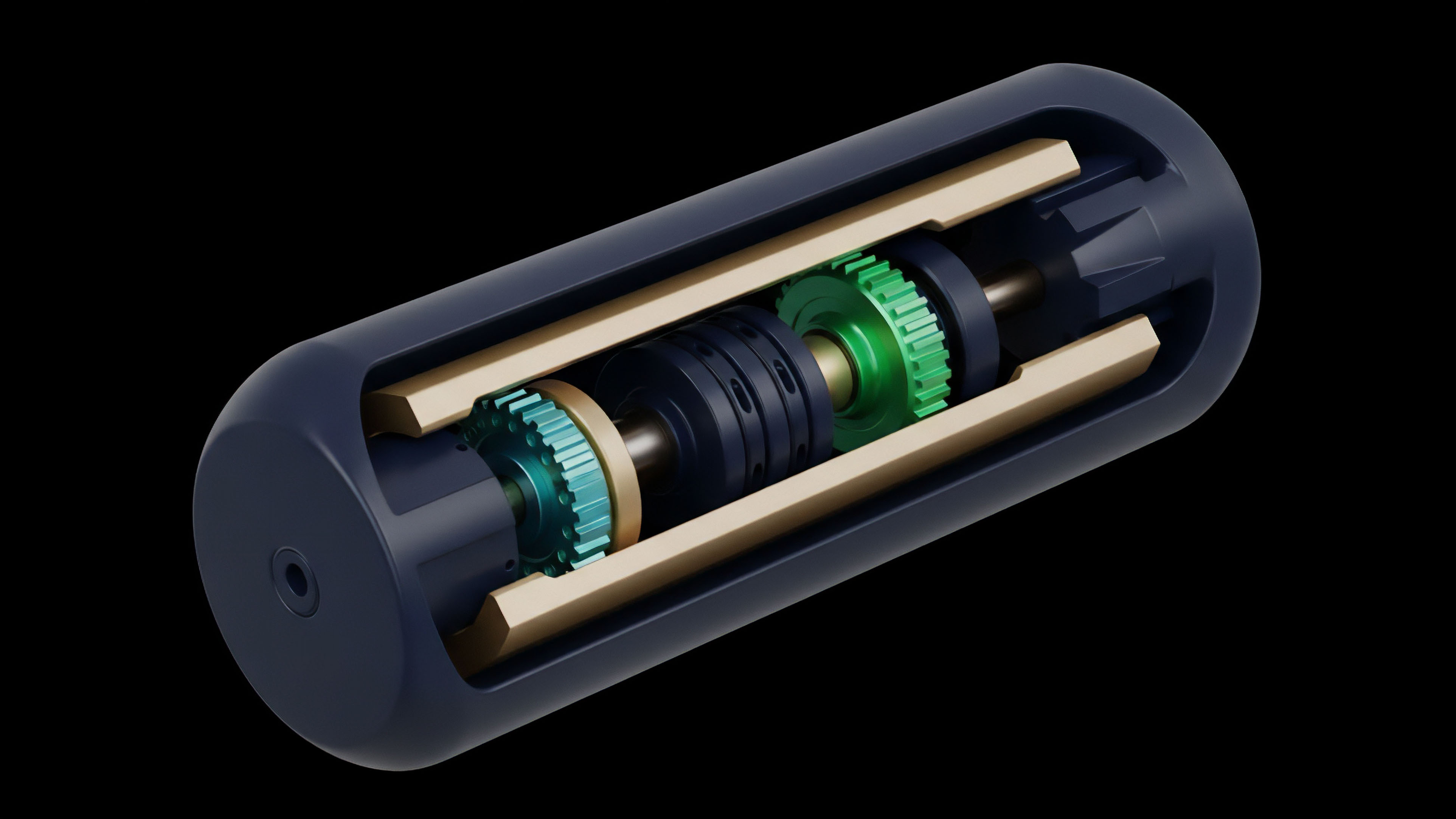
Synthesis of Divergence
The divergence between a successful DVE and a catastrophic one hinges entirely on the fidelity of the Pricing Engine Layer. The atrophy pathway ⎊ systemic failure ⎊ occurs when the latency of the off-chain oracle, combined with a sudden, violent shift in the underlying asset’s volatility ( Stochastic Volatility Jump ), causes the pool’s calculated hedge to lag the market’s true risk. The ascend pathway, conversely, is characterized by the system’s ability to maintain a Negative Correlation to Volatility Spikes by proactively increasing margin requirements and widening spreads before the volatility shock is fully priced in by the market.
The critical pivot point is the Time-Series Analysis used to predict the next 15-minute volatility jump; a model that is too simple leads to ruin, while a computationally expensive, high-fidelity model becomes economically unviable due to transaction costs.

Novel Conjecture
The systemic stability of a Decentralized Volatility Engine is inversely proportional to the Governance Participation Rate of its liquidity providers, conditional on the sophistication of the system’s automated risk model. Specifically, high LP participation in minor parameter changes introduces behavioral biases and political instability into a system that requires machine-like, objective execution of complex quantitative risk management ⎊ the system performs best when LPs trust the code and remain passive, or when governance is restricted to a small, mathematically-competent subset of stakeholders.

Technology Specification Volatility Risk Filter (VRF)
The Novel Conjecture necessitates an architectural defense against human-driven risk injection. The solution is a Volatility Risk Filter (VRF) , a technology specification for a new governance module.

VRF Core Design Parameters
- The VRF automatically activates when the pool’s Systemic Risk Score (calculated by the Pricing Engine) exceeds a 75% threshold, signaling elevated risk.
- Upon activation, the VRF imposes a temporary Governance Lockout ⎊ a 72-hour period during which no parameter changes, including fee adjustments or margin ratio tweaks, can be voted on or executed by the DAO. This prevents panicking LPs from making politically motivated, mathematically unsound changes during a crisis.
- Only a pre-approved set of emergency, mathematically validated actions ⎊ such as a proportional increase in the global margin floor or a forced reduction in the maximum open interest ⎊ can be executed during the lockout. These actions must be voted on before the crisis and stored as Immutable Crisis Scripts within the VRF contract.
This VRF design acknowledges the reality that human behavior ⎊ Behavioral Game Theory ⎊ is the greatest threat to a mathematically rigorous system, offering a structural solution to enforce the quantitative model’s supremacy during periods of market stress. What new forms of Macro-Crypto Correlation become dominant when the systemic risk of decentralized options is no longer tied to individual protocols but to the security and latency of cross-chain communication bridges?

Glossary

Maintenance Margin

Systems Risk

Systemic Risk

Time Series Analysis

Value Accrual

Protocol Physics

Strike Price Selection

Risk Settlement Layer

Pricing Engine