

Essence
The challenge of creating a robust options market in a decentralized environment centers on liquidity and capital efficiency. Traditional order books, which rely on active market makers to quote bids and asks, struggle with the high transaction costs and latency of current blockchain architectures. The solution, AMM-based options protocols , re-engineers this model by creating automated liquidity pools where users can buy or sell options against a pre-funded pool.
The protocol algorithmically manages the pool’s risk exposure and calculates prices based on a dynamic volatility surface. This approach removes the need for individual market makers, instead relying on liquidity providers (LPs) who deposit assets into the pool in exchange for a share of the trading fees. The core function of these protocols is to provide continuous, automated pricing and settlement for derivatives, making risk transfer permissionless and accessible to a broader range of participants.
The fundamental shift from order book to automated market maker architecture changes how options are priced, traded, and settled in a decentralized context.
This design fundamentally changes the dynamics of risk management in DeFi. Instead of relying on specific counterparties for each trade, a trader interacts with a shared pool of capital. The pool acts as a counterparty for all trades, absorbing the risk and distributing the rewards among LPs.
The architectural challenge then becomes how to correctly price the options within this pool, manage the pool’s delta and vega exposure, and incentivize LPs to maintain a healthy balance of assets. The design must account for the non-linear nature of options payouts and the potential for significant impermanent loss for LPs when the underlying asset’s price or volatility changes dramatically.


Origin
The genesis of AMM-based options protocols can be traced directly to the limitations exposed by early decentralized exchanges (DEXs) and the success of spot AMMs.
The first attempts at decentralized options trading mirrored traditional finance with order books. These early systems, however, quickly became non-viable. The cost of placing, modifying, and canceling orders on high-gas blockchains like Ethereum made continuous market making prohibitively expensive.
This environment favored a new model where liquidity could be passive and always available. The success of Uniswap’s constant product formula (x y=k) demonstrated that automated liquidity provision was feasible for simple spot pairs. The application of this model to options required significant adaptation.
Options pricing is not linear like spot trading; it depends on factors like time decay, volatility, and strike price. Early iterations of options AMMs, such as Hegic, attempted to simplify the model, but often struggled with capital efficiency and accurately pricing the complex risk profile. The development of more sophisticated models, often drawing on variations of the Black-Scholes formula, allowed protocols to manage the pool’s exposure more effectively.
The shift from order book to AMM represents a move from high-frequency, active trading to a more passive, algorithmically managed liquidity provision model, a direct response to the specific technical constraints of decentralized networks.


Theory
The theoretical foundation of options AMMs departs from the simple constant product formula of spot AMMs. A key concept is the virtual liquidity pool , where the price of the option is not determined by the ratio of tokens in the pool, but by an external pricing model.
This model is typically a variation of the Black-Scholes model, adjusted for the specific parameters of the decentralized environment. The protocol must calculate the theoretical value of the option based on inputs like the underlying price, strike price, time to expiration, and implied volatility. The pool’s inventory ⎊ the number of calls or puts it holds ⎊ determines its risk exposure.
A primary concern for LPs is impermanent loss , which is significantly more complex in options than in spot trading. In an options AMM, LPs are effectively taking on the risk of being short volatility. When a trader buys an option, the pool sells it, and if the option moves deep in the money, the pool’s losses can exceed the premium collected.
To mitigate this, many protocols employ dynamic pricing and automated hedging.
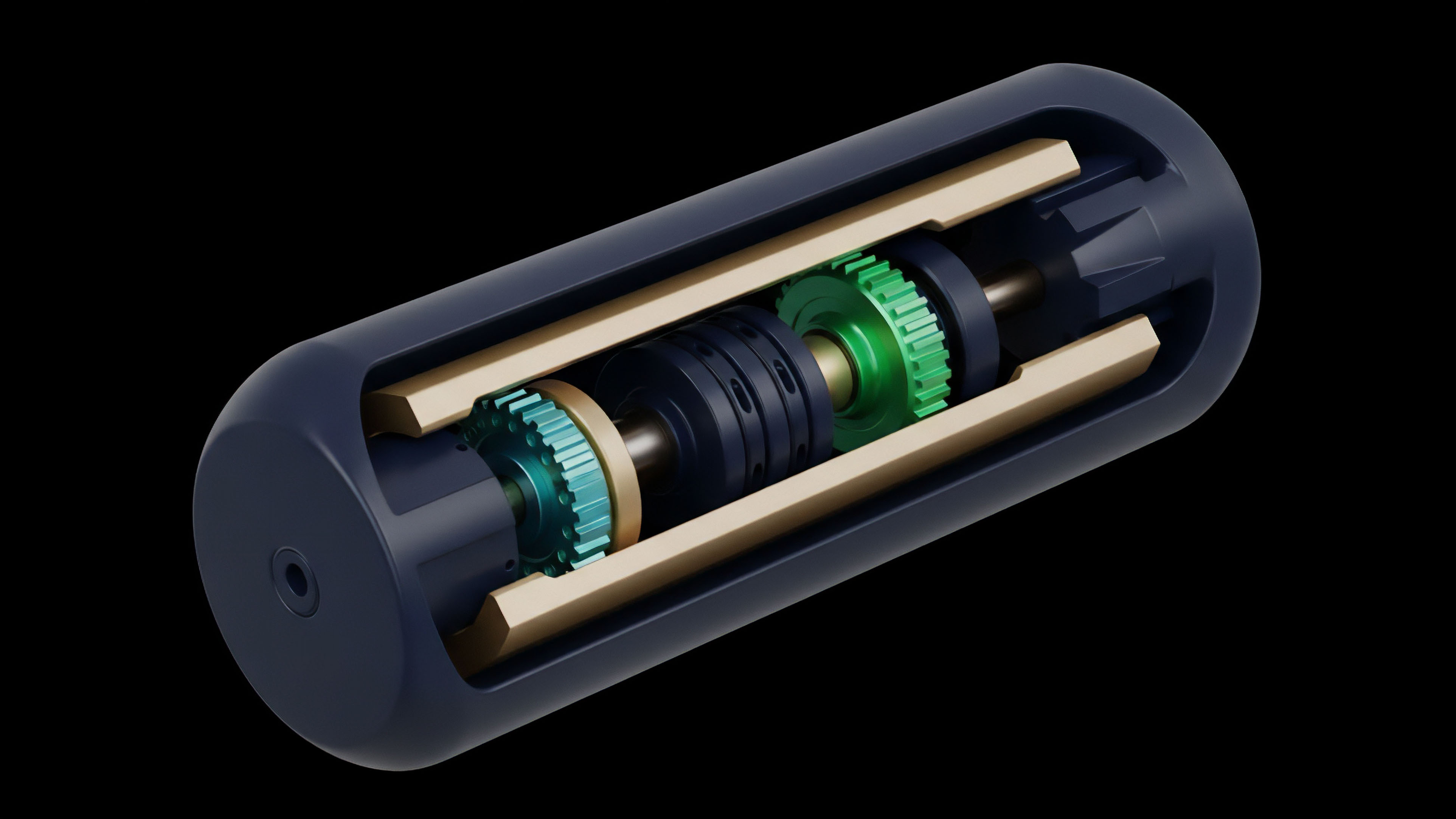
Pricing and Greeks Management
The protocol must manage its exposure to the “Greeks,” which measure the sensitivity of an option’s price to various factors.
- Delta: Measures the change in option price relative to a change in the underlying asset price. The protocol’s goal is often to keep the pool delta-neutral by automatically trading the underlying asset on a spot market or by dynamically adjusting the fee structure to incentivize traders to balance the pool’s inventory.
- Gamma: Measures the rate of change of delta. High gamma means the delta changes rapidly, making hedging more difficult. This is a significant challenge for AMMs, as it requires frequent rebalancing.
- Vega: Measures the sensitivity of the option price to changes in implied volatility. LPs in an options AMM are fundamentally short vega. If implied volatility rises, the value of the options in the pool increases, potentially causing losses for LPs.

Liquidity Provision and Risk Balancing
The mechanism for liquidity provision must balance the need for deep liquidity with the risk of impermanent loss for LPs. Some protocols utilize single-sided liquidity pools, allowing LPs to deposit only the underlying asset or the stablecoin, simplifying the process but concentrating the risk. Others implement dynamic fees that adjust based on pool utilization and inventory levels.
This dynamic fee structure acts as a disincentive for traders who attempt to arbitrage the pool’s pricing, ensuring the pool remains solvent.


Approach
The implementation of options AMMs varies significantly across protocols, reflecting different approaches to managing risk and capital efficiency. These variations are often centered on the trade-off between simplicity for LPs and accuracy of pricing for traders.

Comparison of Options AMM Models
| Model Parameter | Model 1: Single-Asset Pools (e.g. Dopex) | Model 2: Dynamic Pricing & Hedging (e.g. Lyra) |
|---|---|---|
| Liquidity Provision | LPs deposit a single asset (e.g. ETH or USDC) into separate pools for calls and puts. | LPs deposit a pair of assets (e.g. ETH and USDC) into a pool that manages both sides of the market. |
| Risk Mitigation for LPs | LPs receive rebates for impermanent loss; risk is isolated to specific pools. | Protocol performs automated delta hedging on LPs’ behalf; risk is managed actively by the system. |
| Pricing Mechanism | Utilizes a Black-Scholes variation; price discovery is driven by pool utilization and inventory. | Calculates implied volatility (IV) from on-chain data and uses a dynamic fee model to balance risk. |

The Role of Delta Hedging
The most sophisticated options AMMs incorporate automated delta hedging. When a trader buys an option from the pool, the protocol calculates the pool’s new delta exposure. If the pool becomes significantly short delta, the protocol automatically executes a trade on a spot DEX to buy the underlying asset.
This process aims to keep the pool’s overall position neutral, protecting LPs from directional price movements. This mechanism introduces a new layer of complexity, as it requires precise timing and efficient execution of trades, often requiring high gas limits and reliable oracles.
Automated delta hedging is a critical mechanism for mitigating impermanent loss in options AMMs, transforming passive liquidity provision into an actively managed strategy.
The strategic choice for protocol design often comes down to how much risk to offload onto the LPs versus how much to manage algorithmically. Simpler protocols place more risk on LPs, offering higher potential returns but requiring LPs to understand and accept that risk. More complex protocols attempt to manage the risk internally, but introduce new vectors of smart contract risk and execution risk from the hedging process itself.


Evolution
The evolution of options AMMs has moved from basic, capital-inefficient designs toward more complex, risk-managed architectures. The initial designs struggled with a core problem: LPs were essentially shorting volatility without adequate compensation or protection. This led to a series of innovations focused on improving capital efficiency and mitigating impermanent loss.

Addressing Impermanent Loss and Capital Efficiency
The first generation of options AMMs often required LPs to deposit large amounts of collateral to cover potential losses, leading to poor capital efficiency. The next iteration introduced mechanisms like dynamic fees that increase when a pool’s inventory becomes unbalanced. This makes it more expensive for traders to take positions that increase the pool’s risk, thus encouraging a return to equilibrium.
The concept of collateral optimization has also been key. Instead of requiring LPs to lock up collateral in a vault, some protocols allow LPs to utilize their capital in other yield-generating activities, such as lending protocols, while still serving as collateral for the options pool. This composability enhances overall capital efficiency within the DeFi ecosystem.

The Shift to Volatility Surfaces
Early options AMMs often treated each option strike and expiration as a separate, isolated pool. This creates fragmentation and makes it difficult to price options accurately across the entire volatility surface. The most advanced designs are moving toward a unified model where all options are priced based on a single, algorithmically determined volatility surface.
This approach allows for more precise pricing and more efficient risk management, as the protocol can manage its overall exposure rather than managing individual pools in isolation.
- Risk Isolation: Early designs isolated risk to individual pools, leading to high capital requirements for each strike.
- Dynamic Pricing: The introduction of dynamic fees based on pool utilization to incentivize balance.
- Automated Hedging: Implementation of automated delta hedging to protect LPs from directional price risk.
- Composability: Integration with other DeFi primitives to optimize collateral usage and generate additional yield for LPs.


Horizon
Looking forward, the development of options AMMs points toward a future where derivatives are foundational building blocks for a more resilient and sophisticated decentralized financial system. The current challenge lies in moving beyond simple calls and puts to offer a full range of structured products. The ability to create complex strategies ⎊ like automated yield strategies that sell covered calls ⎊ without relying on centralized counterparties represents a significant architectural shift.

The Volatility Index and Structured Products
The next step in options AMM evolution is the creation of a reliable, decentralized volatility index. By aggregating the implied volatility data from multiple on-chain options pools, protocols can create a “VIX-like” index for specific crypto assets. This index would enable the creation of new financial products, such as volatility tokens or futures contracts based on volatility itself.
The future of options AMMs lies in their ability to serve as a primitive layer for creating complex, composable structured products and volatility-based derivatives.
This architecture also allows for the creation of synthetic assets that mimic traditional financial products. For instance, by combining a spot position with a put option, users can create a synthetic long position with downside protection. The efficiency and accessibility of options AMMs will allow for these strategies to be implemented automatically and permissionlessly. The ultimate goal is to create a fully decentralized volatility surface where risk can be transferred and managed with precision and efficiency, fundamentally changing how risk is priced and distributed across the ecosystem.

Glossary

Bridge Design

Defi Architectural Design

Oracle Security Design

Margin Engine Design

Derivatives Protocol Design Constraints

Proactive Security Design

Defi Protocol Interoperability Challenges

Defi Protocol Governance Data

Decentralized Exchanges