
Essence
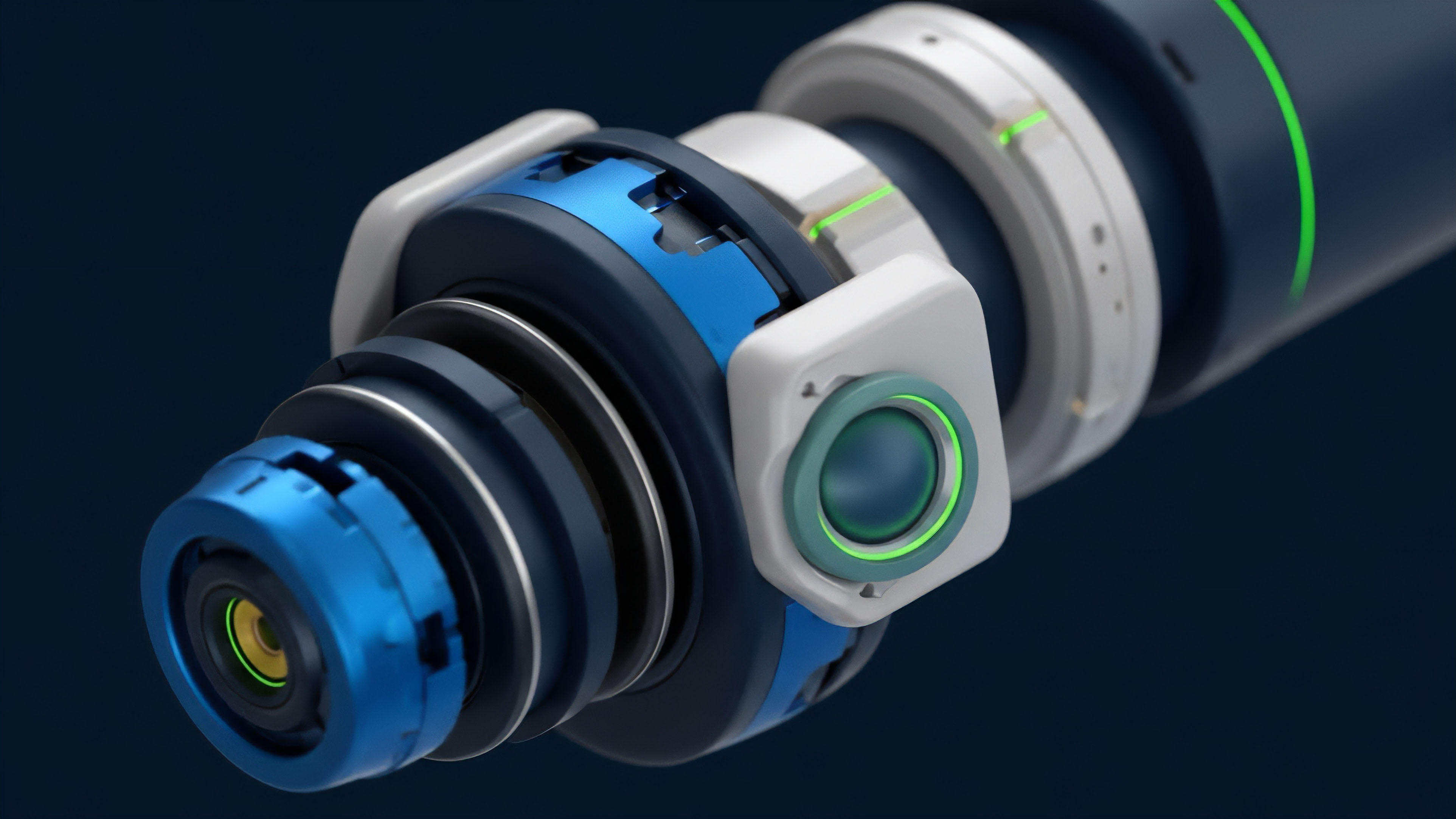
The Smart Contract Risk Engine functions as the central nervous system for a decentralized options protocol, governing the parameters of collateralization, margin requirements, and liquidation thresholds. It is a set of autonomous rules and calculations, executed on-chain, designed to mitigate systemic risk without human intervention. The engine’s primary objective is to ensure the solvency of the protocol by dynamically adjusting to market volatility and price changes.
This mechanism replaces the traditional, human-led risk committee of a centralized exchange with auditable code. It determines precisely how much collateral is required for a user to mint an option, take a leveraged position, or provide liquidity to a derivatives pool. The calculations are continuous, often relying on oracle feeds to pull real-time asset prices and volatility data into the protocol.
A Smart Contract Risk Engine acts as the autonomous governor of a decentralized options protocol, enforcing solvency through real-time collateral management and liquidation mechanisms.
This architecture is critical for decentralized finance (DeFi) derivatives because it addresses the core challenge of counterparty risk in a trustless environment. In traditional finance, a clearinghouse or prime broker manages risk, ensuring that a default by one participant does not cascade across the system. In DeFi, the risk engine performs this role by automatically liquidating positions that fall below predefined margin requirements.
This process is essential for maintaining capital efficiency and preventing a protocol from becoming undercollateralized. The engine must balance two competing objectives: maximizing capital efficiency to attract liquidity providers and traders, while simultaneously maintaining sufficient collateral buffers to withstand extreme market movements. The design of this engine dictates the overall risk profile and resilience of the entire derivatives platform.


Origin
The concept of an automated risk engine in crypto finance first emerged in the context of perpetual futures exchanges, specifically to address the problem of maintaining solvency in high-leverage trading environments.
Early centralized exchanges (CEX) like BitMEX introduced the concept of an insurance fund and auto-deleveraging (ADL) systems to handle liquidations that occurred below the bankruptcy price of a position. These systems, while effective, were opaque and relied on a centralized entity to manage the insurance fund and execute the ADL process. The transition to decentralized derivatives introduced a new set of constraints.
The “code is law” principle requires that all risk logic be transparent and verifiable on the blockchain. The earliest DeFi options protocols faced significant challenges in translating traditional options pricing models, such as Black-Scholes, into efficient smart contracts. Gas costs made continuous, complex calculations prohibitively expensive.
The initial approaches were often simplistic, relying on fixed collateral ratios and basic price checks. This led to capital inefficiency and a higher risk of undercollateralization during periods of rapid volatility. The need for a more sophisticated, capital-efficient, and robust risk management system drove the development of specialized Smart Contract Risk Engines.
These engines evolved from simple collateral checks to dynamic systems that adjust parameters based on market conditions and the specific risk profile of the option positions.
| Risk Management Component | Centralized Exchange Model | Decentralized Risk Engine Model |
|---|---|---|
| Margin Calculation | Off-chain proprietary algorithms; data is private. | On-chain or hybrid calculations; logic is public and auditable. |
| Liquidation Process | Centralized system or designated liquidators; often opaque. | Automated smart contract execution; often incentivized liquidator bots. |
| Counterparty Risk Management | Clearinghouse or internal risk committee. | Algorithmic collateral adequacy checks; insurance funds. |
| Capital Efficiency vs. Safety | Optimized for efficiency by a central authority. | Determined by code parameters; trade-off between safety and efficiency. |


Theory
The theoretical foundation of a Smart Contract Risk Engine for options draws heavily from quantitative finance, specifically the concepts of margin requirements, Value at Risk (VaR), and the “Greeks.” The engine’s function is to quantify and manage the sensitivity of option prices to changes in underlying asset price, time decay, and volatility.

Volatility and Margin Calculation
The engine must determine the required collateral based on the potential movement of the underlying asset. For options, this is more complex than for simple futures because of non-linear payoffs. The core risk components calculated by the engine include:
- Delta Risk: The sensitivity of the option’s price to changes in the underlying asset price. The engine must ensure sufficient collateral to cover potential losses from adverse price movements.
- Gamma Risk: The rate of change of Delta. Gamma exposure increases as the option approaches expiration and the strike price. A risk engine must account for gamma risk to avoid rapid, non-linear losses in collateral.
- Vega Risk: The sensitivity of the option’s price to changes in implied volatility. This is particularly relevant in crypto markets, where volatility can spike dramatically. The engine must dynamically adjust margin requirements based on the volatility surface.
The engine’s primary task is to calculate the Portfolio Margin Requirement for each user. This involves simulating potential future market states and determining the maximum loss a user’s portfolio could sustain under adverse conditions (VaR calculation). For a protocol to remain solvent, the collateral held must always exceed this potential loss.

Liquidation Thresholds and Solvency
A critical design choice for a risk engine is the determination of the liquidation threshold. This threshold is the point at which a user’s position is automatically closed to prevent further losses to the protocol. The threshold is often calculated as a percentage of the collateral value, where a drop below this level triggers liquidation.
The engine must carefully calibrate this threshold ⎊ setting it too high reduces capital efficiency; setting it too low increases the risk of bad debt for the protocol. The engine must also account for potential slippage during liquidation, ensuring that even after a price drop, the collateral can be sold at a price that covers the outstanding debt.
The risk engine’s core challenge is balancing capital efficiency with systemic safety, requiring dynamic adjustments to margin requirements based on real-time volatility and portfolio risk metrics.

The Role of Oracles and Latency
The integrity of the risk engine relies entirely on the accuracy and timeliness of its data inputs. Price oracles feed the underlying asset prices to the smart contract. Latency in oracle updates creates a window of vulnerability during periods of high volatility.
If the price moves rapidly between oracle updates, a position can become undercollateralized before the risk engine can trigger liquidation. The engine must therefore incorporate a buffer against this latency risk, often by requiring higher collateral ratios or using more sophisticated oracle designs that update more frequently or provide a time-weighted average price (TWAP) to smooth out short-term spikes.


Approach
The implementation of Smart Contract Risk Engines in decentralized options protocols typically follows one of two primary approaches: fully on-chain risk calculation or a hybrid model combining off-chain calculation with on-chain execution.

On-Chain Calculation
In a fully on-chain model, all calculations related to margin requirements and liquidation thresholds are performed directly by the smart contract. This provides maximum transparency and decentralization. However, this approach faces significant limitations due to gas costs.
Complex calculations involving volatility surfaces and portfolio-wide VaR are computationally intensive. Protocols adopting this approach often simplify their models, using more basic risk metrics and fixed parameters to minimize transaction fees. This trade-off between simplicity and precision can leave protocols vulnerable during extreme market conditions.

Hybrid Calculation with Keepers
The most common and capital-efficient approach involves a hybrid model. The core risk calculations ⎊ such as real-time VaR and margin adequacy checks ⎊ are performed off-chain by a network of incentivized “keepers” or liquidators. These keepers monitor user positions and identify those that fall below the margin requirement.
When a position becomes undercollateralized, the keeper executes a transaction on-chain to trigger the liquidation process. This off-chain calculation allows for much greater complexity and precision in risk modeling, as it avoids the gas cost constraints of the blockchain. The on-chain smart contract simply verifies the liquidation trigger and executes the pre-programmed logic.
The design of the liquidation mechanism itself is a key part of the approach. Protocols must choose between different methods for closing a position:
- Dutch Auction: The collateral is sold off at a decreasing price until a buyer (liquidator) takes the position. This method ensures that the collateral is sold quickly but may result in significant slippage for the user.
- Fixed Liquidation Penalty: A fixed penalty fee is applied to the liquidated position, with a portion going to the liquidator and the remainder returning to the protocol’s insurance fund.
- Insurance Fund Coverage: The protocol’s insurance fund covers any shortfall from a liquidation, protecting the protocol from bad debt.
| Risk Engine Approach | Pros | Cons |
|---|---|---|
| Fully On-Chain Calculation | Maximum decentralization and transparency; no reliance on off-chain actors. | High gas costs; limited computational complexity; potential for less precise risk modeling. |
| Hybrid Model (Off-Chain Calculation) | Lower gas costs; allows for complex risk modeling and capital efficiency. | Reliance on off-chain keepers; potential for front-running liquidations; less transparent. |


Evolution
Smart Contract Risk Engines have evolved from simple collateralization checks to sophisticated, multi-layered systems. Early models were simplistic, treating each position in isolation with a fixed collateral ratio. The evolution has been driven by a pursuit of capital efficiency and systemic resilience, moving toward portfolio-level risk management.
The initial models often required users to overcollateralize significantly, making them inefficient for professional traders. The first major step in evolution was the shift from single-asset collateral to cross-margin systems. In a cross-margin setup, a user’s entire portfolio acts as collateral, allowing gains in one position to offset losses in another.
This significantly improved capital efficiency. A more advanced development has been the implementation of portfolio margin systems, where the risk engine calculates margin requirements based on the net risk of all positions combined. This approach recognizes that certain option strategies, such as spreads, have lower overall risk than individual positions.
The engine calculates the combined risk using VaR or similar models, requiring less collateral than the sum of individual position requirements. The next significant evolution is the integration of dynamic volatility surfaces. Instead of relying on fixed volatility assumptions, modern risk engines adjust margin requirements in real-time based on the market’s current implied volatility (Vega risk).
This allows the protocol to react more accurately to changing market sentiment and volatility spikes. The evolution of these engines is fundamentally tied to the development of better oracle solutions. The introduction of high-frequency oracles and TWAP feeds has reduced latency risk, enabling protocols to safely lower collateral requirements and offer higher leverage.
The current frontier involves integrating these engines with automated strategies, where the risk engine itself becomes a component in a larger, automated trading system.
The transition from fixed, single-asset collateral models to dynamic, portfolio-based risk engines reflects the industry’s progression toward capital efficiency and sophisticated risk management.


Horizon
Looking ahead, the next generation of Smart Contract Risk Engines will focus on three areas: real-time risk modeling, composable risk primitives, and regulatory compliance. The future of risk modeling involves moving beyond static VaR calculations to real-time Conditional Value at Risk (CVaR) modeling. CVaR measures the expected loss beyond the VaR threshold, providing a more robust measure of tail risk. Integrating this into smart contracts will require significant computational advances, likely through off-chain calculations validated by zero-knowledge proofs. This would allow protocols to dynamically adjust margin requirements based on specific market conditions and potential tail events. A critical challenge for decentralized finance is managing systemic risk across protocols. The current risk engines operate in silos. A position on Protocol A might be collateralized by an asset derived from Protocol B, creating a complex web of interconnected risk. The future demands composable risk primitives ⎊ standardized risk parameters that can be shared across protocols. This would allow a global risk engine to calculate the net risk of a user’s entire DeFi portfolio, regardless of where the assets or positions reside. This creates a more robust system where a failure in one protocol does not necessarily cause contagion across the entire ecosystem. Finally, the regulatory landscape will shape the future of these engines. As regulators begin to focus on decentralized derivatives, protocols will need to provide auditable risk reporting. Future risk engines will likely be designed with built-in features for generating regulatory-compliant risk metrics and reports. This will be essential for bridging the gap between decentralized finance and traditional institutional capital. The ultimate goal is to create a system where risk is not just managed by code, but where the code itself can be proven to be safer than traditional systems.

Glossary

Dynamic Margin Calculation

Smart Contract Security Contagion

Smart Contract Compatibility

Smart Contract Development and Security

Shared State Risk Engines

Smart Contract Updates

Smart Contract Circuit Breakers

Financial Settlement Engines

Protocol Margin Engines