

Essence
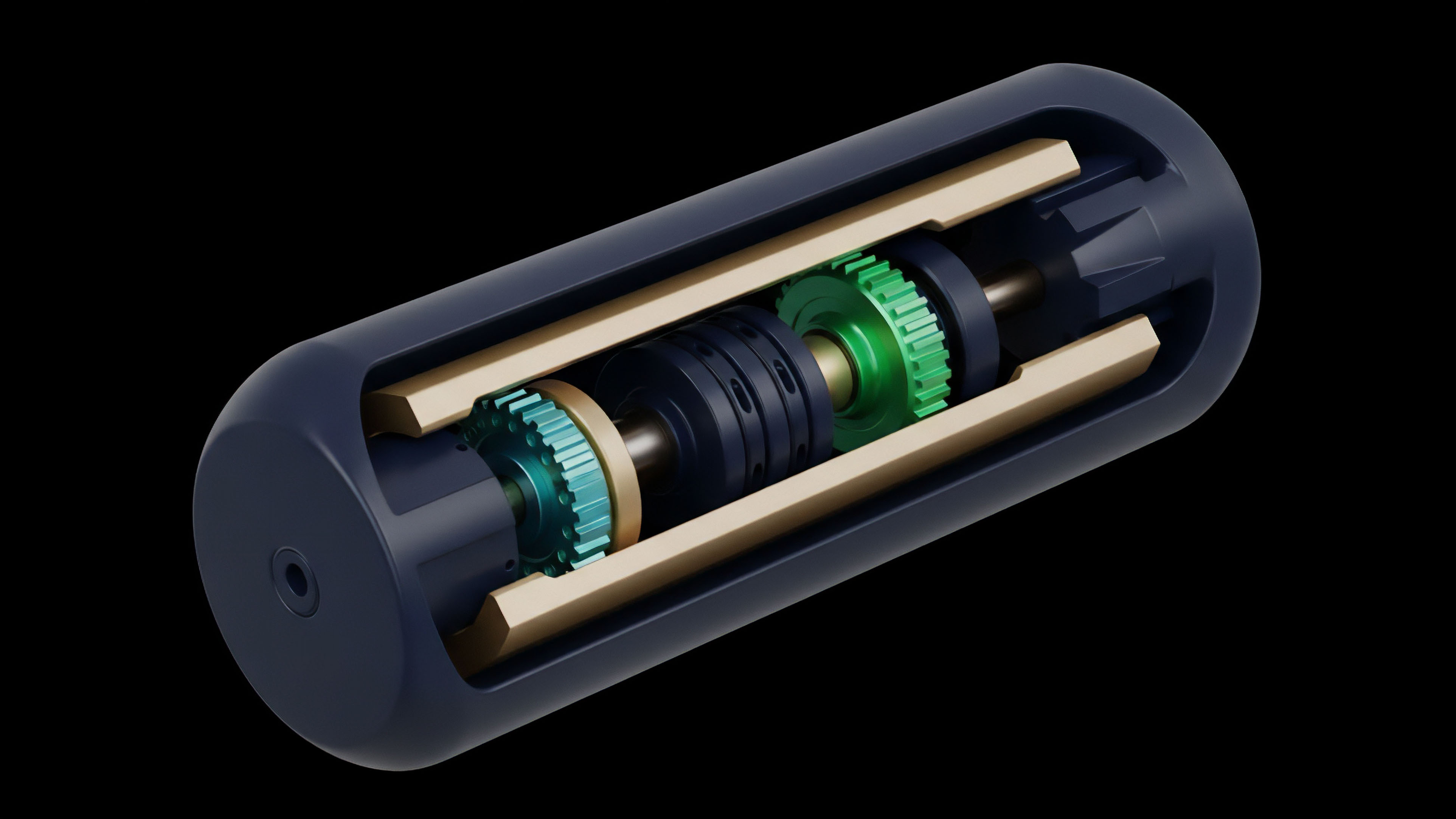
The Portfolio Delta ⎊ which we term the Delta Shield ⎊ is the consolidated, first-order sensitivity of a portfolio’s value to a single unit change in the underlying asset’s price. It is the instantaneous risk signature of the entire book, aggregating the directional exposure from every option, future, and spot position held. This metric is foundational, translating a complex, non-linear options surface into a single, actionable number representing the net exposure to the underlying asset ⎊ typically Bitcoin or Ether.
The Delta Shield moves beyond simple directional betting; it is a system of risk accounting. For an options market maker, a near-zero Delta Shield is the operational target, signifying a position that is theoretically market-neutral and profits primarily from capturing the volatility risk premium, rather than guessing price direction. Any deviation from this neutral state represents a capital commitment to a directional view, a decision that must be actively managed.
The Portfolio Delta is the aggregated directional risk signature of a book, translating non-linear option payoffs into a single, manageable exposure value.
In decentralized finance, the Delta Shield takes on systemic relevance. It is the transparent proxy for the health and leverage of the options protocol itself. If the collective Delta Shield of all users within a decentralized vault or options AMM becomes heavily skewed ⎊ say, a massive net short delta ⎊ the protocol faces structural liquidation risk if the underlying asset moves sharply against that consensus position.
This is a critical feedback loop in decentralized market microstructure.

Risk Accounting and Net Exposure
The concept’s power lies in its aggregation. It is not sufficient to know the delta of a single option contract ⎊ a deep out-of-the-money call might have a delta of 0.05. The Delta Shield sums the products of the delta and the notional size for every instrument.
This summation reveals the total synthetic position the portfolio holds in the underlying asset. A Delta Shield of +500 means the portfolio is synthetically long 500 units of the underlying asset, requiring 500 units of the asset to be sold (or shorted via a perpetual swap) to achieve true directional neutrality. This simple number governs the scale of all subsequent hedging operations.


Origin
The concept of Delta originates from the rigorous, continuous-time framework of the Black-Scholes-Merton (BSM) model, where it was defined as the partial derivative of the option price with respect to the underlying asset price. This was a theoretical breakthrough, offering the first mathematically sound basis for hedging options ⎊ the realization that a dynamic hedge using the underlying asset could theoretically render the option a riskless asset, thereby determining its fair price. The transition of this concept to the crypto domain ⎊ and its re-framing as the Delta Shield ⎊ was necessitated by the fundamental divergence in market physics.
Traditional BSM assumed continuous trading, constant volatility, and risk-free rates derived from sovereign debt. None of these assumptions hold in the crypto space.

The Digital Translation of a Classic Metric
The core principles were retained, but the inputs were fundamentally re-engineered for a system characterized by:
- Extreme Volatility: The underlying asset’s price moves in discrete, high-magnitude jumps, challenging the assumption of continuous rebalancing and making Delta Hedging a costly, discrete-time operation.
- Non-Zero Funding Rates: The “risk-free rate” component is replaced by the volatile funding rate of perpetual swaps, which introduces a cost-of-carry that dynamically shifts the P&L of the hedge itself. This is a systemic architectural friction that must be priced into the Delta Shield management strategy.
- Protocol Physics: Settlement is not guaranteed by a central clearinghouse but by smart contract execution. The delta calculation must therefore account for the potential for liquidation cascades and the inherent counterparty risk embedded in the protocol’s margin engine.
The Delta Shield concept evolved from a theoretical pricing tool into a practical survival metric ⎊ a necessary first step in building a resilient derivative architecture atop volatile, permissionless ledgers.


Theory
The quantitative analysis of the Delta Shield begins with the aggregation function, but the true complexity lies in the non-linear second-order effects ⎊ Gamma ⎊ and the local volatility structure. A simplistic summation of deltas is a point-in-time snapshot, an inadequate measure in a market defined by rapid movement.

The Local Delta Problem
In high-volatility crypto markets, the assumption of constant volatility across strike prices ⎊ a simplification often used in introductory models ⎊ is entirely invalid. The volatility skew is pronounced, meaning out-of-the-money options trade at a higher implied volatility than at-the-money options. This asymmetry means the delta of an option is not just a function of time and price, but also a function of the local volatility surface.
The Delta Shield’s true utility is unlocked by pairing it with Gamma exposure, which quantifies the rate of change in the portfolio’s directional risk.
This requires the use of Local Volatility Models or Stochastic Volatility Models to calculate a more accurate delta, one that correctly anticipates how the option’s sensitivity will change as the underlying asset moves toward the higher-implied-volatility strikes. This is where the pricing model becomes truly elegant ⎊ and dangerous if ignored. The market is constantly pricing in a non-Gaussian distribution of future outcomes ⎊ the heavy tails are the reality, and the Delta Shield must account for them.

The Systemic Role of Gamma
The relationship between Delta and Gamma is the core of options trading risk. Gamma is the second derivative, measuring the rate of change of the delta with respect to the underlying price.
- Positive Gamma: The portfolio’s delta moves against the market’s movement, allowing the hedger to buy low and sell high, a necessary component for profitable market making.
- Negative Gamma: The portfolio’s delta moves with the market, forcing the hedger to sell low and buy high, accelerating losses during sharp moves ⎊ this is the risk signature of a net option seller.
- Gamma Exposure: The total Gamma of the Delta Shield dictates the frequency and cost of rebalancing. A high negative Gamma book requires constant, expensive re-hedging, a drain on capital efficiency.
This interplay is where the intellectual challenge lies. It forces us to think of risk not as a static position, but as a dynamic process ⎊ a flow of information and capital ⎊ that requires constant maintenance.
| Component | Description | Crypto-Specific Adjustment |
|---|---|---|
| Individual Option Delta | Sensitivity of one option contract to the underlying price. | Must use a volatility-skew-adjusted pricing model. |
| Notional Exposure | The contract size in terms of the underlying asset. | Crucial for scaling the individual delta to the portfolio level. |
| Perpetual Swap Delta | The delta of the futures hedge, typically 1.0 (or -1.0 for short). | Incorporates the cost-of-carry (funding rate) into the hedge P&L. |
| Spot Delta | The delta of the underlying held in a wallet, always 1.0. | Used as the final adjustment layer for a target-neutral book. |

Approach
The pragmatic application of the Delta Shield involves a process known as Delta Hedging , which is the continuous adjustment of the underlying asset position to maintain a desired net delta ⎊ typically zero. In crypto, this process is fraught with technical and financial friction, making the choice of hedging instrument paramount.

Dynamic Delta Hedging Mechanics
The most common instrument for hedging the Delta Shield is the perpetual swap, due to its high liquidity and low capital requirement (via leverage). The process is inherently cyclical:
- Delta Calculation: The Delta Shield is calculated across all options and spot holdings, providing the net exposure.
- Rebalance Trigger: A pre-defined threshold is set ⎊ say, the net delta deviates from zero by more than 10 BTC equivalent.
- Execution: A corresponding trade is executed on a perpetual swap exchange to bring the net delta back to the target. If the Delta Shield is +15 BTC, 15 BTC worth of perpetual swaps are shorted.
- Friction Cost Accounting: The cost of the trade ⎊ exchange fees, slippage, and the perpetual swap’s funding rate ⎊ is recorded and subtracted from the theoretical profit, determining the true efficiency of the Delta Shield strategy.
The systemic risk in this approach is the Funding Rate Volatility. A consistently positive funding rate on the perpetual swap hedge can transform a theoretically profitable options selling strategy into a negative-carry position, slowly bleeding capital even if the delta is perfectly managed. The market maker is effectively paying a premium to hold the short delta hedge, a cost that must be passed to the option buyer.

The Need for Precision in Execution
The frequency of rebalancing ⎊ the discreteness of the hedge ⎊ is a trade-off between minimizing transaction costs and minimizing Gamma Risk. A market maker who rebalances too infrequently accepts higher Gamma risk; a sharp move will expose the portfolio to losses before the hedge can be adjusted. A market maker who rebalances too often incurs higher transaction costs.
The optimal rebalancing frequency is an optimization problem governed by the underlying asset’s volatility and the cost structure of the execution venue. The sophistication of the Delta Shield manager is visible in this single, critical choice.


Evolution
The management of the Delta Shield has evolved from a simple centralized function to a complex, multi-venue optimization problem.
The initial phase was dominated by centralized exchanges (CEXs) where all options and perpetuals resided on the same platform, simplifying cross-margining and hedging. The emergence of decentralized options protocols introduced fragmentation and new systemic risks.

Fragmentation and Cross-Protocol Risk
The contemporary challenge is that the options position (the risk) often sits on an on-chain DeFi protocol, while the hedge (the Delta Shield adjustment) must be executed on a high-liquidity, low-latency CEX perpetual market. This bifurcation creates two layers of risk:
- Execution Risk: The latency and slippage incurred when executing the hedge across two distinct financial systems ⎊ a CEX and a smart contract ⎊ can lead to momentary, unhedged exposure during critical volatility spikes.
- Basis Risk: The price feed used by the on-chain options protocol may diverge from the price feed used by the CEX for the perpetual hedge. This basis risk means the hedge is imperfect, even if the Delta Shield calculation is mathematically sound.
This architectural reality means the Delta Shield manager must view their risk holistically, across the entire system, not just within a single account. The failure of one component ⎊ a slow oracle, a CEX API outage ⎊ can cascade into a systemic failure of the entire hedging strategy.

Systemic Contagion and Liquidation Cascades
The most significant evolution in risk management has been the need to model Systemic Contagion. Options protocols, particularly those utilizing automated market makers (AMMs) or vaults that sell options, accumulate a net negative Gamma exposure to the market. When the market moves sharply, these protocols are forced to re-hedge by buying the underlying asset at elevated prices, which further pushes the price up ⎊ a positive feedback loop.
- Protocol-Level Delta Stress: The net delta of the entire protocol can become a liability, requiring the protocol itself to act as a forced buyer or seller.
- Liquidation Thresholds: If a user’s individual Delta Shield is managed poorly, their collateral falls below the maintenance margin, triggering a liquidation. This liquidation event adds selling pressure (or buying pressure) to the underlying market, which impacts the delta of all other options in the system, creating a cascade.
The Delta Shield is no longer a personal risk metric; it is a vector for systemic instability within the decentralized architecture.


Horizon
The future of the Delta Shield lies in its complete automation and decentralization, moving from a manual or centralized execution process to an autonomous, on-chain risk engine. This is the realm of Vol-as-a-Service ⎊ a system where the complexity of options Greeks management is abstracted away and provided as a transparent, auditable service layer.

Autonomous Delta Shield Protocols
The next generation of options protocols will feature internal, automated Delta Shield managers. These systems will use decentralized perpetual swaps or synthetic assets as their hedging counterparties, eliminating the need for CEX reliance. The key innovations will center on capital efficiency and latency.
| Feature | Current CEX-Centric Management | Future Decentralized Delta Shield |
|---|---|---|
| Execution Latency | Milliseconds (API-dependent) | Block-time (Deterministic settlement) |
| Counterparty Risk | Centralized Exchange/Custody Risk | Smart Contract Risk (Auditable code) |
| Capital Efficiency | High (Cross-margining) | Moderate (Requires over-collateralization or novel pooling) |
| Funding Rate Risk | Inherent cost of the hedge | Internalized via options AMM or custom synthetic products |
The critical step is the creation of a Decentralized Basis Market ⎊ a robust, liquid, and low-slippage market for synthetic assets or perpetual swaps that exists entirely on-chain. Without this, the Delta Shield will remain tethered to the centralized exchange infrastructure, retaining its inherent systemic risks.
The ultimate goal of the Delta Shield is to transition from a manual risk-management task to an autonomous, on-chain solvency mechanism.

The Regulatory Arbitrage Vector
As these autonomous systems mature, the Delta Shield becomes a key regulatory concern. By synthetically replicating the exposure of a traditional derivative through a series of on-chain primitives ⎊ spot tokens, perpetual swaps, and options ⎊ protocols are performing the function of a regulated entity without the associated compliance overhead. The Delta Shield acts as the audit trail for the synthetic exposure, but its decentralized, global nature challenges jurisdictional oversight. The future of this metric will be defined not just by mathematical rigor, but by the legal and political frameworks that attempt to define the systemic boundary of a permissionless financial system. The greatest question we face is whether the inherent transparency of the on-chain Delta Shield can preempt the need for traditional, opaque regulatory reporting.

Glossary

Option Pricing Theory

Directional Exposure

Systemic Fragility

Options Market Making

Basis Risk

Funding Rate

Asset Price Sensitivity

Capital Efficiency

Smart Contract Risk