

Essence
DeFi composability defines the technical architecture where decentralized protocols function as interoperable building blocks. This characteristic allows developers and users to stack protocols, creating new financial products from existing primitives. The core idea is that a single unit of capital can be utilized simultaneously across multiple protocols, maximizing capital efficiency.
For options and derivatives, this capability is fundamental. It enables the creation of complex structured products where the underlying collateral itself generates yield, or where liquidity from one market (e.g. a spot market) can be seamlessly integrated into another (e.g. an options writing protocol). The architecture’s value lies in its ability to reduce friction and create novel risk profiles by allowing protocols to read and write states from one another.
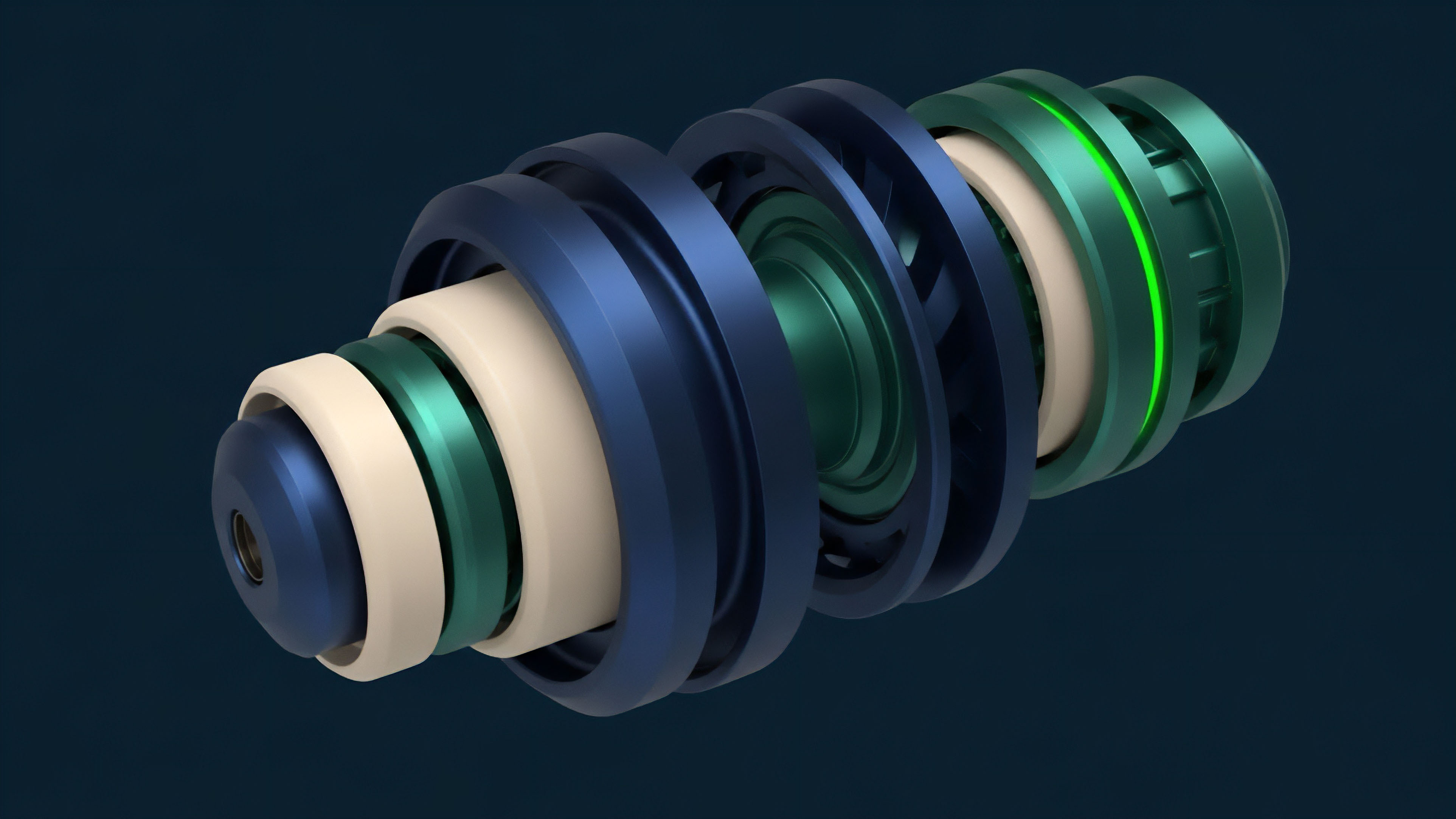
Composability transforms financial primitives into programmable building blocks, allowing capital to perform multiple functions simultaneously.
This stacking of financial logic creates a new class of derivative instruments. Traditional options rely on simple collateral, but composable DeFi options can utilize yield-bearing collateral. A user might deposit an asset into a lending protocol, receive a yield-bearing token (like cTokens or aTokens), and then use that token as collateral to write an option.
The option’s premium calculation must account for the additional yield generated by the underlying collateral. This changes the fundamental economics of options trading by lowering the opportunity cost of holding collateral.


Origin
The concept of composability emerged from the earliest DeFi protocols, primarily MakerDAO and Uniswap.
MakerDAO’s Collateralized Debt Position (CDP) model created the first significant financial primitive where deposited collateral could generate a new asset (DAI). This established the initial template for capital efficiency and collateral management. Uniswap introduced automated market makers (AMMs), which created permissionless liquidity pools.
The key insight was that a liquidity provider’s position in an AMM pool (represented by an LP token) could be used as collateral in another protocol.
The first generation of options protocols built directly upon these foundational layers. Early platforms like Opyn used existing collateral standards and leveraged the yield generated by lending protocols. This approach contrasted sharply with traditional finance, where each derivative contract operates in a silo with its own specific collateral requirements and clearing house.
DeFi’s origin story is defined by this shift: from a centralized, fragmented system to a single, interconnected, and open-source financial operating system where the components are designed to interact without permission.


Theory
The theoretical foundation of composability centers on the concept of systemic risk and capital efficiency. From a quantitative perspective, composability changes how we model risk contagion. When protocols are deeply interconnected, a failure in one protocol’s logic (e.g. a smart contract exploit or a liquidation failure) can propagate across the entire system.
This creates a high degree of correlation between seemingly disparate assets and positions.
Options pricing models must adapt to this interconnected environment. The standard Black-Scholes model assumes a constant risk-free rate and a specific volatility surface. In a composable environment, the risk-free rate is replaced by a variable yield derived from a lending protocol, and the underlying asset’s price dynamics are linked to the stability of multiple protocols.
The primary challenge for options market makers is modeling these second-order dependencies. A protocol’s smart contract risk must be priced into the option premium, alongside the standard market risk (delta, gamma, vega).

Risk Contagion and Liquidation Cascades
The most significant theoretical risk introduced by composability is the potential for liquidation cascades. When collateral in a lending protocol is used to back an options position, a sudden drop in the underlying asset’s price can trigger a series of liquidations. If the lending protocol liquidates the collateral, the options protocol’s position may become undercollateralized.
This can create a feedback loop where liquidations in one protocol increase selling pressure, causing further liquidations across other protocols in the stack.
| Traditional Finance Derivatives | DeFi Composability Derivatives |
|---|---|
| Isolated risk silos per clearing house | Interconnected systemic risk across protocols |
| Static collateral requirements (cash, T-bills) | Dynamic, yield-bearing collateral (aTokens, LP tokens) |
| Manual or centralized liquidation processes | Automated, smart contract-driven liquidations |

Capital Efficiency and Cross-Margining
The theoretical benefit of composability is the reduction of capital requirements through cross-margining. In traditional finance, a trader must post separate collateral for a futures position and an options position. In DeFi, composability allows a single collateral pool to secure multiple positions across different protocols.
This reduces the total capital at risk for the user and significantly improves capital utilization for market makers. The challenge lies in creating a unified margin engine that can accurately calculate risk across different protocols with varying liquidation logic and collateral standards.


Approach
The practical application of composability in crypto options relies on a “stacking” methodology. This approach involves selecting specific protocols to fulfill distinct functions in a financial strategy. The current approach for market makers involves creating vaults that automatically execute strategies using composable primitives.

Automated Options Vaults
A typical approach for a covered call strategy involves depositing ETH into a lending protocol like Aave to earn yield. The resulting yield-bearing token (aETH) is then deposited into an options vault protocol (like Ribbon Finance or Dopex). The vault automatically sells covered call options against the aETH collateral.
This creates a dual-yield strategy where the user earns both lending yield and options premiums. This approach optimizes capital utilization, but introduces complexity in risk management, as the collateral’s value is dependent on the lending protocol’s stability and the option’s volatility profile.

Liquidity Provision and Options Pricing
Composability enables options protocols to source liquidity from various decentralized exchanges. Instead of maintaining separate order books, a protocol can dynamically pull liquidity from AMMs like Uniswap or Balancer. This approach improves pricing accuracy by reflecting real-time market data from the underlying spot markets.
However, it also creates dependencies on the AMM’s parameters, such as impermanent loss, which must be accounted for in the options pricing model.
The primary challenge for market makers in a composable environment is managing the real-time interaction between protocol logic and market dynamics.
- Collateral Sourcing: Deposit base assets into a lending protocol to acquire yield-bearing collateral tokens.
- Options Writing: Use the yield-bearing tokens as collateral to write options, typically in an automated vault structure.
- Liquidity Aggregation: The options protocol aggregates liquidity from external AMMs to ensure efficient pricing and settlement.
- Risk Monitoring: Real-time monitoring of collateral health, liquidation thresholds in the lending protocol, and option position deltas.

Evolution
The evolution of composability has progressed from simple, single-chain stacking to complex, cross-chain financial engineering. Early composability focused on combining protocols within the Ethereum mainnet. This was constrained by high gas fees and network congestion, which limited the frequency and complexity of interactions.
The transition to Layer 2 solutions and other high-throughput blockchains (like Arbitrum, Optimism, and Solana) significantly reduced transaction costs, enabling more complex strategies.

Cross-Chain Composability Challenges
The next stage of evolution involves extending composability across different chains. This introduces new complexities in trust and security. Cross-chain bridges allow assets to move between environments, but they also represent a significant point of failure.
If a bridge is exploited, the collateral backing an option on a different chain may lose its value, creating a systemic failure across multiple networks. This creates a new challenge for risk modeling: how to price the risk of a bridge failure into a derivative contract.
The shift from single-chain to multi-chain composability increases capital efficiency while simultaneously introducing new layers of systemic risk from bridge security vulnerabilities.

Standardization and Modular Design
The current evolution emphasizes standardization. The development of standards like ERC-4626 (Vault Standard) allows different protocols to interact seamlessly by providing a common interface for yield-bearing vaults. This reduces integration risk and facilitates the creation of new options protocols.
The future of composability requires a modular design where components (collateral management, risk engine, settlement layer) can be swapped out easily without affecting the overall system. This allows for rapid iteration and specialization of protocols.


Horizon
Looking ahead, the horizon for composability in options markets centers on two key areas: enhanced risk management systems and the creation of fully autonomous, cross-chain derivatives. The current challenge is that risk management is still largely siloed, despite the interconnected nature of the underlying assets. Future systems must account for the interconnectedness of protocols.

Automated Risk Management and Simulation
The next generation of options protocols will require sophisticated simulation engines to model the systemic risk of composable strategies. These engines must simulate liquidation cascades and stress-test the entire stack under various market conditions. This requires a shift from static risk assessments to dynamic, real-time risk modeling.
This approach moves beyond simply calculating individual position risk to calculating the collective risk of all interconnected protocols. This allows market makers to dynamically adjust collateral requirements based on real-time network conditions and protocol health.

The Fully Composable Derivatives Stack
The ultimate goal is a fully composable derivatives stack where every component is modular and interchangeable. This stack would consist of specialized protocols for specific functions. One protocol might specialize in options pricing, another in collateral management, and a third in settlement.
This allows for maximum efficiency and innovation. For instance, a new options protocol could launch by simply integrating existing collateral and settlement protocols, rather than building everything from scratch. This modularity reduces time to market and allows for specialization.
| Component | Current State | Horizon State |
|---|---|---|
| Collateral Management | Siloed, single-protocol collateral | Cross-protocol, yield-bearing collateral with unified margin |
| Risk Modeling | Static risk assessment | Dynamic, real-time systemic risk simulation |
| Settlement Layer | Single-chain settlement | Cross-chain settlement with trustless message passing |

Glossary

Financial Derivatives Stack

Option Premiums

Liquidity Provision

Multi Protocol Composability

Composability Graph

Composability Risks

Protocol Composability Challenges

Options Markets

Composability Contagion