

Essence
The CLOB-AMM Hybrid Model establishes a dual-layered liquidity environment ⎊ a structural requirement for institutional-grade trading ⎊ that synthesizes the deterministic nature of limit orders with the continuous availability of algorithmic pools. This architecture functions as a unified clearinghouse for decentralized derivatives, addressing the chronic fragmentation that plagues early-stage liquidity venues. By allowing professional market makers to provide liquidity via a limit order book while simultaneously maintaining an automated backstop, the protocol ensures that execution remains resilient during periods of extreme volatility.
Hybrid models unify discrete order placement with continuous algorithmic liquidity to stabilize derivative pricing.
The character of this system is defined by its ability to resolve the tension between price precision and execution certainty. In traditional central limit order books, liquidity is a function of active participation; if market makers withdraw, the book thins, and slippage increases. In contrast, the automated market maker component of the hybrid system provides a programmatic floor, ensuring that even in the absence of active limit orders, a counterparty exists for every trade.
This synergy creates a more robust market microstructure that can withstand the adversarial conditions of the digital asset environment.


Origin
The path toward this synthesis began when pure automated market makers failed to accommodate the non-linear risk profiles of options. Initial decentralized finance protocols relied on constant product formulas, which proved inadequate for pricing instruments with sensitive Greek profiles like Gamma and Vega. Professional traders required the ability to set precise limit orders to manage their delta exposure ⎊ a requirement that traditional AMMs could not facilitate.
The hybrid solution appeared as a technical resolution to these constraints, merging the flexibility of order books with the robust execution of automated pools.
The integration of off-chain matching with on-chain settlement provides the requisite speed for professional market making.
Historically, the evolution of these venues mirrored the development of electronic trading in traditional finance, yet it was accelerated by the unique constraints of blockchain technology. Early attempts to build full on-chain order books were hampered by high gas costs and slow block times, leading to a migration toward off-chain matching engines. Simultaneously, the success of liquidity vaults demonstrated that passive capital could be effectively utilized to backstop professional trading activity.
The CLOB-AMM Hybrid Model represents the culmination of these two parallel developments, providing a scalable and efficient venue for complex financial instruments.


Theory
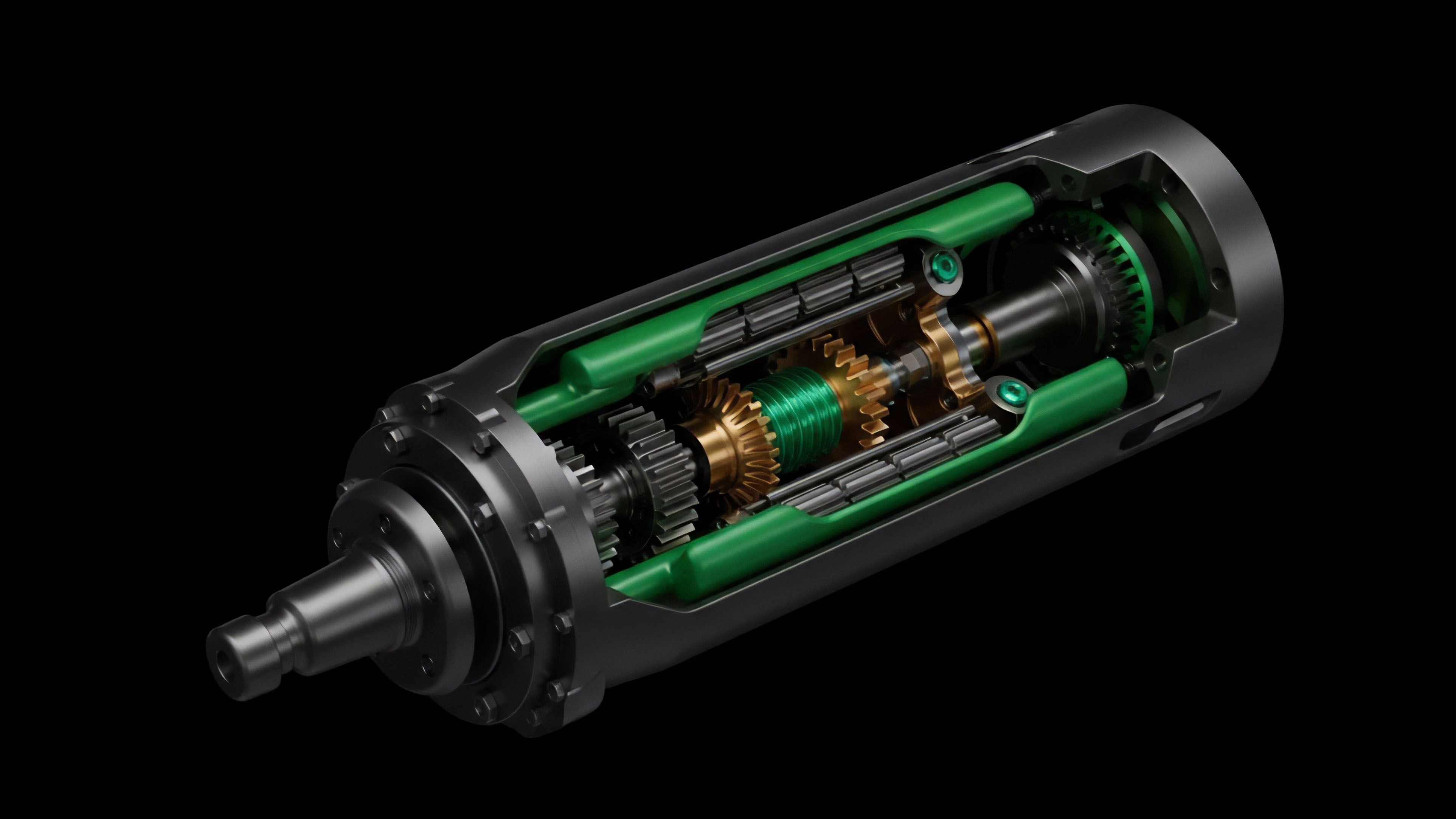
Quantitative stability in the CLOB-AMM Hybrid Model is maintained through a mathematical interplay between active and passive liquidity. The order book acts as the primary venue for price discovery, where market participants compete to narrow the spread. The AMM component functions as a secondary layer, utilizing a virtual liquidity curve to absorb orders ⎊ regardless of size ⎊ that fall outside the current book depth.
This structure prevents price gapping and ensures that the protocol remains operational even when external market makers withdraw their capital.

Structural Constituents
- Order Matching Engine: Coordinates the sequence and execution of limit orders off-chain to achieve high-frequency performance while minimizing latency.
- Virtual Liquidity Curve: Provides a programmatic price floor and ceiling based on the total collateral held within the protocol vaults.
- Skew Adjustment Logic: Dynamically alters AMM pricing to incentivize trades that reduce the net delta of the protocol, maintaining system solvency.
- Risk Engine: Monitors margin requirements in real-time and executes liquidations to prevent the propagation of failure across the network.
The pricing mechanism within the AMM layer often incorporates a volatility surface derived from the limit order book. This ensures that the automated component remains synchronized with the broader market, reducing the risk of arbitrage-induced drain on the liquidity pool. By anchoring the AMM to the real-time data provided by the CLOB, the system achieves a level of capital efficiency that exceeds either model in isolation.


Approach
Implementation of this model requires a sophisticated balance between off-chain performance and on-chain security.
Most protocols utilize a centralized or semi-decentralized sequencer to handle the high-frequency matching of orders, while the final state transitions are recorded on the blockchain. This method allows for a trading experience that rivals centralized exchanges while preserving the self-custodial nature of decentralized finance.
| Metric | Pure AMM | Pure CLOB | Hybrid Model |
|---|---|---|---|
| Execution Speed | Variable | High | High |
| Capital Efficiency | Low | High | Optimal |
| Liquidity Continuity | Guaranteed | Intermittent | Guaranteed |
| Price Discovery | Algorithmic | Participant Driven | Synthesized |
Professional market makers interact with the system via high-speed APIs, placing and canceling orders with minimal friction. Separately, retail participants can trade directly against the AMM or the order book, depending on which venue offers the best execution price. This dual-access methodology ensures that the protocol captures a wide range of order flow, further deepening the available liquidity and reducing the cost of hedging for all users.


Evolution
The development of hybrid systems has moved toward cross-margining and multi-asset collateralization.
Early iterations functioned as isolated silos, but modern engines allow for the offsetting of risks across different derivative products. This progression has increased the overall capacity of the system, allowing for larger trade sizes and lower slippage. The transition from simple vaults to complex risk engines has made the CLOB-AMM Hybrid Model the standard for high-performance decentralized trading.
Algorithmic backstops within hybrid systems mitigate the risk of liquidity droughts during extreme market volatility.
Alongside these technical improvements, the governance of these protocols has become more decentralized. Decision-making regarding risk parameters, such as Liquidation Ratios and Margin Requirements, is increasingly handled by token-based governance systems. This shift ensures that the protocol remains aligned with the interests of its users, while also providing a mechanism for rapid response to changing market conditions.
The result is a more adaptive and resilient financial infrastructure.


Horizon
The trajectory of these systems points toward a future defined by zero-knowledge proofs and cross-chain liquidity aggregation. As the technology matures, we will see the removal of centralized sequencers in favor of decentralized matching networks that maintain privacy and speed. The ultimate manifestation of the CLOB-AMM Hybrid Model will be a global, invisible liquidity layer that powers the next generation of financial applications, providing a level of resilience that traditional centralized systems cannot match.
| Parameter | Current State | Future State |
|---|---|---|
| Matching Engine | Centralized Sequencer | ZK-Decentralized |
| Collateral Type | Single Asset | Omni-Chain Assets |
| User Privacy | Public Orders | Encrypted Books |
| Settlement Speed | Block-Dependent | Instant Finality |
The integration of Artificial Intelligence into the risk management layer will further refine the efficiency of these models. Automated agents will be able to adjust skew parameters and liquidity provision strategies in real-time, anticipating market moves before they occur. This will lead to a state where the CLOB-AMM Hybrid Model functions as a self-optimizing financial organism, capable of providing deep liquidity and stable pricing under any market condition.

Glossary

Hybrid Security
Layer 2 Clob Migration

Financial Automation

Risk Management Systems

Market Risk Monitoring System Accuracy

Institutional Hybrid

Skew Adjustment Logic

Derivative Pricing

Automated Market Maker