
Essence
Smart contracts exist in a state of sensory deprivation. Blockchains are deterministic state machines that cannot natively perceive or verify data outside their own ledger. This isolation ensures security and consensus but renders the protocol blind to the price of an asset, the outcome of a physical event, or the temperature of a city.
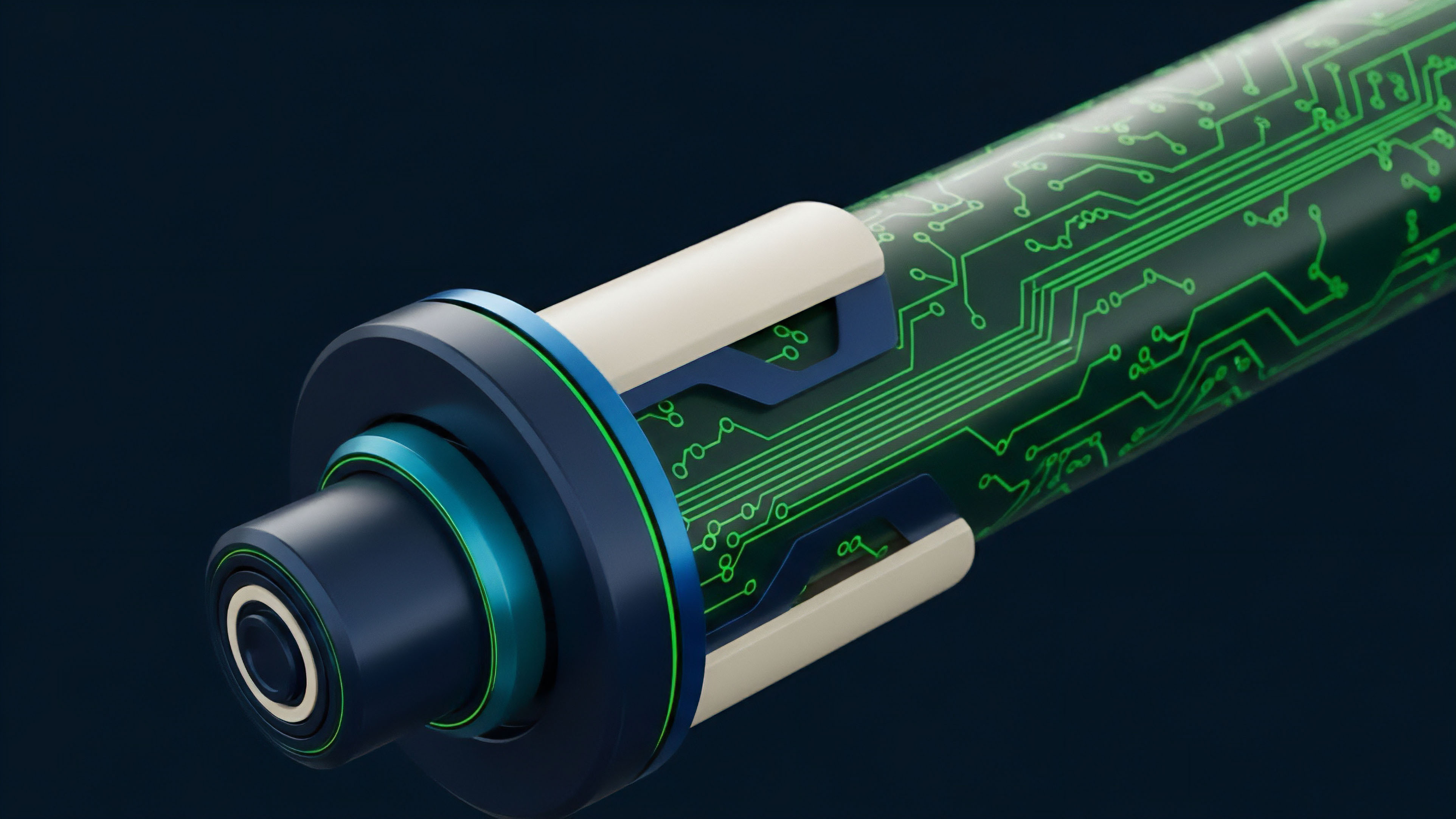
Blockchain Powered Oracles serve as the cryptographic bridge that resolves this deprivation, translating external entropy into machine-readable attestations.
Blockchain Powered Oracles act as the vital sensory organs for decentralized protocols, enabling deterministic code to interact with stochastic external data through cryptographic validation.
These systems function by aggregating data from multiple independent sources and reaching a consensus on the truth of that data before delivering it to a smart contract. Within the context of crypto options, these oracles provide the price feeds requisite for calculating the value of underlying assets, determining the strike price fulfillment, and triggering automated liquidations. The integrity of the entire derivative market rests upon the assumption that the oracle feed is accurate and resistant to manipulation.
The relationship between the oracle and the smart contract is one of trust minimization. Instead of relying on a single centralized entity, Blockchain Powered Oracles utilize decentralized node networks. Each node fetches data, signs it, and contributes to a collective value.
This architecture ensures that no single actor can subvert the feed without incurring a significant cost or facing cryptographic penalties.


Origin
The necessity for decentralized data feeds became apparent during the early development of decentralized finance (DeFi). Initial attempts to provide external data relied on centralized APIs, which created single points of failure. If the API provider went offline or delivered incorrect data, the smart contract would execute based on false information, leading to catastrophic financial losses.
This vulnerability is known as the Oracle Problem.
The Oracle Problem describes the inherent conflict between the deterministic nature of blockchains and the subjective, often unreliable nature of external data sources.
To address this, developers looked toward decentralized node networks that could reach a consensus on data. The first generation of these systems focused on price feeds for stablecoins and early lending protocols. Over time, the architecture shifted from simple data relaying to complex aggregation layers that incorporate economic incentives and game-theoretic security.
Blockchain Powered Oracles emerged as a distinct layer of the stack, separating the data provision from the data consumption to ensure a more resilient financial infrastructure.
- Centralized Feeds: Initial data delivery relied on single exchange APIs or proprietary scripts managed by protocol developers.
- Decentralized Node Networks: The transition to multiple independent nodes fetching data from diverse sources reduced the risk of single-point failure.
- Aggregator Models: Modern systems use multiple layers of nodes and data providers to filter out outliers and ensure a robust median price.


Theory
The theoretical foundation of Blockchain Powered Oracles is rooted in game theory and the concept of Schelling points. A Schelling point is a solution that people tend to choose in the absence of communication because it seems natural, special, or relevant. In an oracle network, the Schelling point is the “truth.” Nodes are incentivized to report the same value as the majority.
If a node reports a value that deviates significantly from the consensus, it loses its stake or reputation.
| Oracle Model | Consensus Mechanism | Primary Security Driver |
|---|---|---|
| Schelling Point | Majority Agreement | Economic Rationality |
| Reputation Based | Historical Accuracy | Long-term Participation |
| Staking and Slashing | Cryptographic Commitment | Cost of Corruption |
Quantitatively, the security of an oracle is measured by the Cost of Corruption (CoC) versus the Profit from Corruption (PfC). For a system to remain secure, the CoC must always exceed the PfC. In the context of crypto options, the PfC can be immense, as a small manipulation in the oracle price can trigger massive liquidations or allow for the exercise of out-of-the-money options.
Therefore, Blockchain Powered Oracles must employ rigorous mathematical models to ensure that the economic cost of subverting the consensus is prohibitively high.
Security in decentralized oracle networks is maintained when the economic cost to manipulate the data feed exceeds the potential financial gain from subverting the contract.
The use of medianization is a standard technique to mitigate the impact of malicious actors. By taking the median value of all reported data points, the network can ignore extreme outliers that might be the result of exchange manipulation or node failure. This statistical smoothing provides a more stable and reliable price feed for high-stakes derivative contracts.


Approach
Current implementations of Blockchain Powered Oracles utilize two primary delivery methods: Push and Pull architectures.
Push oracles update the price on-chain at regular intervals or when a specific price deviation occurs. This ensures that the data is always available for smart contracts but incurs high gas costs. Pull oracles, conversely, allow users to fetch the data off-chain and verify it on-chain only when a transaction is initiated.
This method is more gas-efficient and allows for higher frequency updates.
| Feature | Push Architecture | Pull Architecture |
|---|---|---|
| Update Trigger | Time or Deviation | On-demand by User |
| Gas Efficiency | Low (Constant Cost) | High (Pay per Use) |
| Latency | Variable (Interval) | Low (Real-time) |
| Data Availability | Always On-chain | Verified at Execution |
For crypto options, the accuracy of the price at the exact moment of expiry is vital. Protocols often use Time-Weighted Average Prices (TWAP) or Exponential Moving Average Prices (EMA) to prevent flash loan attacks and short-term price manipulation. These methodologies aggregate price data over a specific window, making it much more expensive for an attacker to move the average price significantly.
- Data Sourcing: Nodes fetch prices from multiple centralized and decentralized exchanges to ensure a broad market view.
- Aggregation: The raw data is filtered for outliers and combined using weighted averages or medianization.
- Attestation: Nodes sign the aggregated data with their private keys, creating a cryptographic proof of the reported value.
- Delivery: The signed data is transmitted to the smart contract, where the signature is verified before the data is used for execution.

Evolution
The transition from simple data feeds to high-fidelity, low-latency oracles has been driven by the increasing complexity of DeFi. Early exploits demonstrated that simple oracles were vulnerable to flash loan attacks, where an actor could borrow a massive amount of capital, manipulate the price on a single exchange, and then exploit a protocol that relied on that exchange’s price feed. This led to the development of more sophisticated aggregation techniques that look across the entire market rather than a single source. The emergence of Blockchain Powered Oracles like Chainlink and Pyth has introduced a layer of professional data providers. These entities are not just hobbyists but institutional-grade data firms that provide high-resolution data with low latency. This shift has allowed for the creation of more complex derivative instruments, such as perpetual futures and exotic options, which require real-time data to manage risk and margin requirements. The architecture has also evolved to include cross-chain capabilities. As liquidity fragments across different Layer 1 and Layer 2 networks, oracles must be able to synchronize data across these environments. This ensures that an option contract on one chain can be settled based on the price action occurring on another, maintaining a unified market price.


Horizon
The future of Blockchain Powered Oracles lies in the integration of zero-knowledge proofs (ZKP) and privacy-preserving technologies. ZK-oracles allow a node to prove that a piece of data is true without revealing the data itself or the source. This is particularly relevant for sensitive financial information or private data that needs to be verified on a public blockchain without compromising confidentiality. Simultaneously, the industry is moving toward “Oracle-less” designs for certain types of derivatives, though these remain experimental. These designs rely on internal market mechanisms, such as arbitrage, to discover prices. However, for the vast majority of high-frequency trading and complex options, Blockchain Powered Oracles will remain the primary infrastructure. The focus will shift toward reducing latency even further, reaching sub-second update speeds to match the performance of traditional financial markets. The integration of AI and machine learning into oracle networks is another area of active research. These technologies could be used to detect anomalies in data feeds in real-time, providing an additional layer of security against sophisticated manipulation attempts. As the stakes in decentralized finance continue to grow, the robustness and intelligence of these data bridges will determine the ceiling for the entire market. How do we maintain cryptographic integrity when the source of truth itself becomes an AI-generated hallucination?

Glossary

Low Latency Data

Time-Weighted Average Price

Systems Risk Mitigation

External Data

Node Operator Incentives

Decentralized Node Networks

Medianization Algorithms

Behavioral Game Theory

Decentralized Oracle Networks